
www.automation-mag.com
06
'26
Written on Modified on
BOBST EXPERT K5 gives FAM Ti edge in high-barrier metallized films
The AluBond process improves metal bond strength and barrier performance, enabling new applications, including metallized PLA, and greater product differentiation.
www.bobst.com
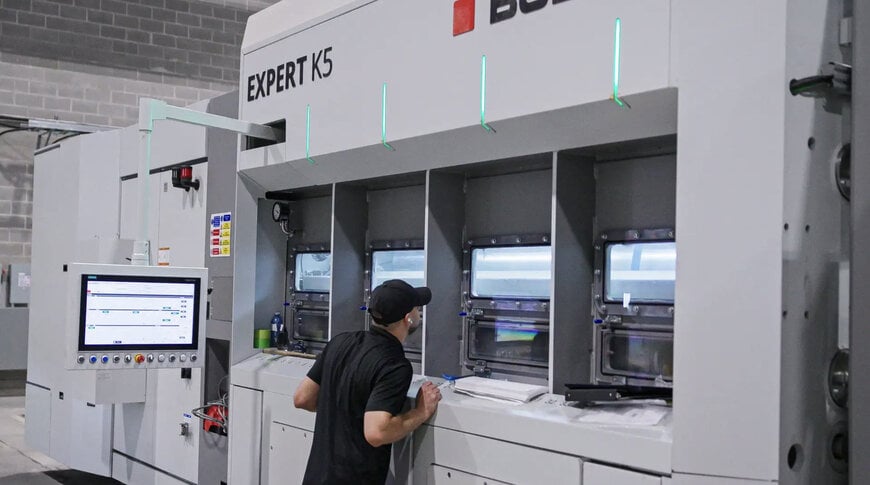
Flexible packaging converters face persistent challenges with metal adhesion and barrier retention when depositing aluminum layers onto sensitive polyolefin and biopolymer films. To address these interfacial bonding limitations, Canadian film supplier FAM Ti Inc. has commissioned North America's first BOBST EXPERT K5 vacuum metallizer equipped with proprietary AluBond technology, expanding the company's capabilities from distribution into specialized barrier film manufacturing.
Interfacial Adhesion Mechanisms in Vacuum Metallization
In conventional physical vapor deposition (PVD) metallization, molten aluminum is evaporated under high vacuum conditions onto moving polymer webs. A primary failure mode in metallized polyolefin films, including biaxially oriented polypropylene (BOPP) and cast polypropylene (CPP), involves low surface energy and weak boundary layer formation, which results in poor metal-to-polymer adhesion. When these films undergo adhesive lamination, extrusion coating, or pouch converting, mechanical stress frequently causes the aluminum layer to peel away from the base film, deteriorating both oxygen and moisture barrier characteristics.
The BOBST AluBond process modifies this interface directly within the vacuum chamber. Rather than functioning solely as a surface treatment, the process chemically alters the web surface during deposition to establish covalent interactions between the nucleating metal atoms and the polymer chains. This inline surface engineering prevents pinhole propagation, improves metal layer uniformity across variable web profiles, and provides consistent metal adhesion across polyolefin substrates and sustainable biopolymers such as polylactic acid (PLA).
Substrate Diversification and Plant Scaling
FAM Ti Inc. entered the flexible packaging sector in 2020 as a distributor of commodity BOPP and polyester substrates. The company subsequently scaled processing infrastructure in 2023 by investing in web slitting machinery and relocating to a 50,000-square-foot facility. A further expansion in 2025 added 56,000 square feet, bringing operational capacity across two facilities to a combined 106,000 square feet.
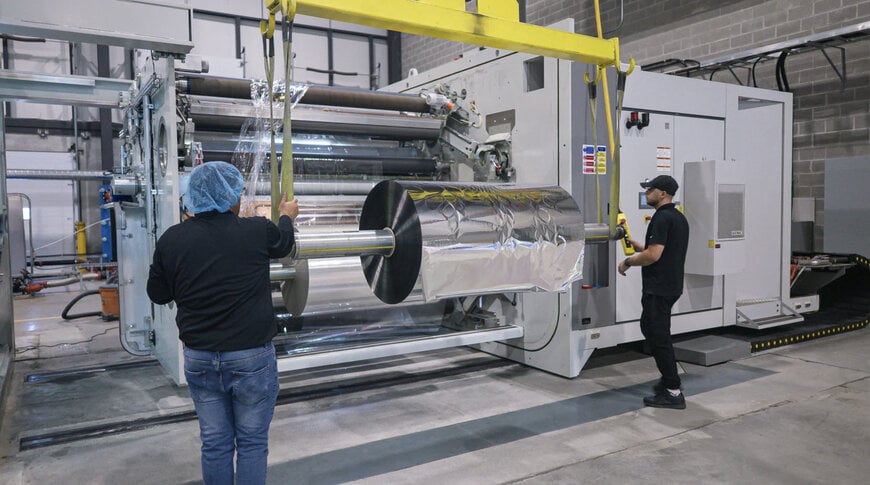
The facility houses six slitters, provides custom toll-slitting services, and maintains a substrate inventory exceeding two million pounds. Integrating the vacuum metallizing platform enables internal product formulation and substrate research, specifically targeting metallized PLA formulations designed for industrial composting specifications and recyclable mono-material structures. The enterprise plans to deploy this metallizing capacity across broader North American supply chains and international distribution networks.
Process Control and Operational Reliability
Integrating vacuum deposition directly into film processing environments requires continuous tension regulation, controlled thermal transfer over cooling drums, and precise evaporation rate monitoring to avoid thermal deformation of thin-gauge films.
The machine delivers process control and reliability across diverse substrates, stated Faisal Younis, Executive at FAM Ti. AluBond provides an operational advantage in metal adhesion, while the system architecture establishes the technical foundation required to scale in-house manufacturing operations.
Additional Context:
This section details technical specifications and competitive benchmarking not included in the original product announcement.
Conventional vacuum metallizing with standard corona or plasma treatment typically achieves metal adhesion values between 1.0 and 1.5 N/15mm on untreated polyolefins, often exhibiting bond decay after prolonged atmospheric exposure. Industry benchmarks for the BOBST AluBond system demonstrate lamination bond strengths exceeding 2.5 to 3.0 N/15mm on BOPP, and up to 4.0 N/15mm on specialty polyolefin films, effectively eliminating adhesive delamination during standard tape testing protocols. The BOBST EXPERT K5 platform operates at web speeds up to 1,000 meters per minute across web widths ranging from 1,650 mm to 3,300 mm, incorporating high-rate evaporation sources and cryogenic vacuum pumping arrays to sustain low operational pressures required for oxygen-sensitive and heat-sensitive web handling.
Edited by Natania Lyngdoh, Induportals editor, with AI assistance.
www.bobst.com
