
www.automation-mag.com
19
'26
Written on Modified on
Gravure Printing Press Automation & Solvent Reduction for Packaging
BOBST launches the MASTER 6003 gravure press to cut solvent consumption and automate inking in packaging production.
www.bobst.com
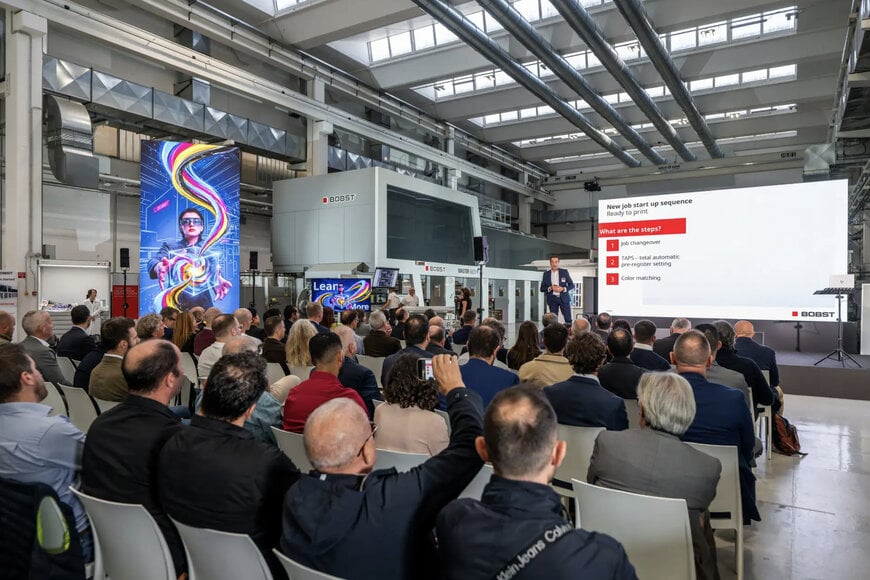
Flexible packaging converters continually face tighter operational margins and increasing environmental scrutiny regarding volatile organic compound emissions, forcing press manufacturers to address fluid consumption and job changeover latency. BOBST has introduced an evolved iteration of its MASTER 6003 platform, integrating a re-engineered fluid delivery circuit and automated makeready modules. The development plan focuses on lowering material losses in gravure packaging production while standardizing machine-operator workflows during short-run conversions.
Fluid Dynamics and Inking Circuit Redesign
In conventional rotogravure converting, maintaining ink transfer stability across wide web widths often requires high volumes of fluid to circulate continuously through exposed ink pans and supply lines. The new machine platform implements the LeanPrint inking system, which reconfigures the pipework geometry and the physical path running from the ink supply tank to the applicator pan. By optimizing these fluid channels, the design reduces the active ink volume circulating through the printing press by 60 percent compared with the previous press configuration.
Reducing the volume of circulated ink limits fluid surface exposure to the surrounding production environment, which cuts solvent evaporation and lowers overall solvent consumption by up to 40 percent. Precise fluid transfer is maintained via an automated pan repositioning system that sets and aligns the pan relative to the engraved cylinder without manual operator intervention. This automated adjustment maintains consistent hydrodynamic ink transfer onto the passing web at elevated operating speeds, eliminating variations caused by manual mechanical positioning.
Automated Cylinder Cleaning and Rapid Job Changeover
Job preparation bottlenecks in gravure printing frequently stem from the mechanical cleaning of cylinder engravings and the physical relocation of heavy fluid reservoirs. To address print quality degradation caused by residual dried ink in microscopic cylinder cells, each printing station incorporates an automated cylinder engraving pre-washing system. The localized cleaning cycle targets dried ink deposits in the smallest cell apertures across all selected units simultaneously, completing the wash sequence within one minute without manual scrubbing.
Mechanical changeovers are further accelerated by a re-engineered auxiliary trolley designed for bilateral fluid tank loading. The trolley architecture allows carts to be docked and extracted from either direction without physical barriers, while an integrated mechanical datum system automatically aligns the cylinder according to the specific job repeat length, removing secondary manual alignment during cylinder blocking. Floor-level positioning reduces the physical lifting required to handle loaded ink containers, improving operational ergonomics during rapid job transitions.
Process Monitoring and Resource Traceability
The press platform introduces integrated telemetry hardware to capture fluid usage and utility consumption metrics across each print run. By utilizing inline pressure measurement transducers, the press system computes real-time data covering active job consumption, the dynamic volume of fluid circulating within the hydraulic circuits, remaining ink reserves, and forecasted fluid quantities required to conclude active production batches.
These metrics are rendered on a dedicated screen within the human-machine interface alongside continuous power and compressed-air telemetry. Tracking active electrical draw and pneumatic usage allows process engineers to detect mechanical resistance, pneumatic leaks, or thermal inefficiencies early in the production run. The centralized logging of fluid and energy metrics directly assists converters in complying with industrial reporting protocols, client supply-chain documentation, and environmental audits regarding resource utilization.
Reflecting on the system engineering, Davide Rossello, Process R&D Manager Gravure at BOBST, stated that the technical developments focus on reducing baseline material consumption, automating repetitive mechanical steps, and delivering quantifiable visibility into production metrics without adding operational complexity to gravure converting lines.
Additional Context:
This section details technical specifications and competitive benchmarking not included in the original product announcement.
Solvent-based gravure printing remains subject to strict emission ceilings under environmental directives such as the European Union Industrial Emissions Directive (Directive 2010/75/EU) and regional volatile organic compound recovery standards. In standard publication and flexible packaging rotogravure installations, solvent retention and evaporation rates dictate the operating load and capital cost of downstream regenerative thermal oxidizers (RTOs) or carbon adsorption solvent-recovery plants. Reducing solvent evaporation at the printing nip directly cuts the thermal energy required for extraction ventilation systems.
Benchmarked against traditional open-fountain inking systems and conventional enclosed-blade chambers, circulating ink volumes in high-speed gravure presses historically ranged between 15 to 30 liters per station, depending on printing width and reservoir design. Systems cutting circulation volume to under 10 liters significantly reduce washing-solvent waste during press flushes. Furthermore, the one-minute automated pre-wash cycle compares favorably with typical manual wash procedures, which routinely consume between 5 to 12 minutes per printing station during complete color rotations, thereby increasing overall equipment effectiveness on converters handling short-to-medium order profiles.
Edited by Natania Lyngdoh, Induportals editor, with AI assistance.
www.bobst.com
