
www.automation-mag.com
22
'26
Written on Modified on
3D IC Electrothermal Codesign via Autonomous EDA Agents
Siemens expands its EDA agentic AI portfolio with NVIDIA accelerated computing to automate multi-physics electrothermal optimization in advanced 3D packaging.
www.siemens.com
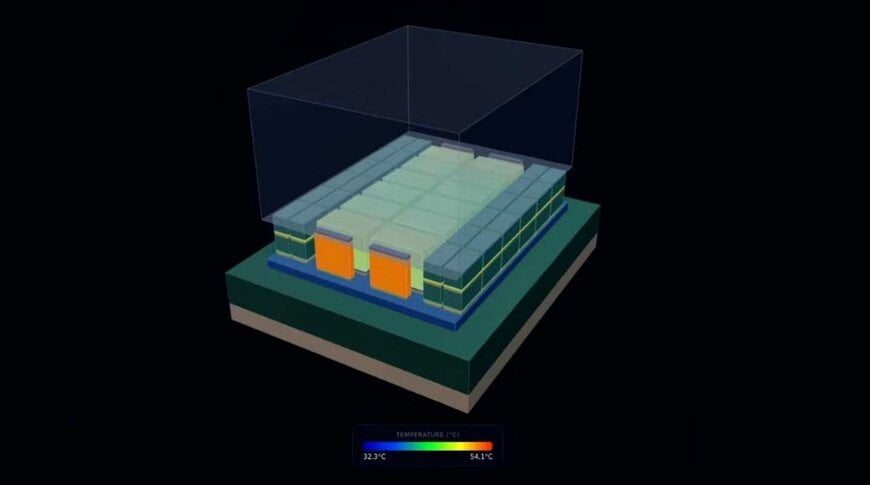
The escalation of compute density and memory bandwidth in artificial intelligence infrastructure has made power delivery and localized thermal dissipation critical limiting factors in semiconductor engineering. In multi-die architectures such as 3D integrated circuits, high power densities create steep thermal gradients and localized hotspots that directly alter electrical parasitics, signal timing, and power delivery network impedance.
Addressing these coupled physical phenomena requires continuous electrothermal codesign. Historically, this demands manual coordination across distinct solver domains, where engineering teams transfer boundary conditions between electrical extraction, power analysis, and thermal simulation tools. Because this iterative process is resource-intensive, design teams have traditionally been restricted to evaluating only a handful of packaging iterations, increasing the probability that unpredicted thermal bottlenecks surface during signoff.
Autonomous Multi-Physics Orchestration in Advanced Packaging
To overcome the latency of manual multi-tool coordination, Siemens has integrated autonomous agentic workflows into its electronic design automation portfolio in collaboration with NVIDIA. The architecture employs the Fuse EDA AI Agent, interfaced with Intelligence Center X, to direct physics-based electrothermal analysis across heterogeneous design parameters.
Once an engineer sets primary performance targets, the system autonomously coordinates a multi-stage flow that evaluates between 200 and more than 500 design alternatives per exploration cycle. The agent assesses parameter variations across heat transfer coefficient boundaries, die placement configurations, power budgets, and material stack-ups. Running between 50 and 100 autonomous reasoning steps over an 8-to-10-hour execution window, the agent diagnoses missed operating targets and isolates root causes within power delivery paths, die physical placements, or package material selections.
Integrating Solver Domains across the Semiconductor Workflow
The autonomous loop coordinates nine discrete engineering stages across seven specialized software environments to execute multiphysics convergence:
Innovator3D IC Integrator serves as the primary floorplanning environment, establishing die placement, interposer routing, and full 3D assembly definitions.
Solido Characterizer generates temperature-dependent Liberty libraries required for downstream power and timing calculations.
mPower Digital calculates instance-level power dissipation, accounting for dynamic temperature variations across the active silicon dies.
Calibre 3DThermal executes thermal signoff and generates granular power maps across the 3D die stack.
Simcenter Flotherm carries out system-level Computational Fluid Dynamics simulations to model heat transfer into chassis, heat sinks, and ambient environments.
Calibre xACT performs temperature-dependent parasitic extraction to capture resistive and capacitive shifts induced by localized heating.
Solido SPICE performs electrical SPICE simulations utilizing updated parasitics and temperature profiles to verify signal and power integrity.
NVIDIA Accelerated Computing and Agent Infrastructure
The agentic framework couples domain-specific engineering solvers with the NVIDIA Agent Toolkit, NVIDIA Nemotron-3.5-Lightning, and CUDA-X acceleration libraries. The computing stack utilizes specialized components to manage workflow execution:
Nemotron open models manage subflow reasoning, synthesis, and tool invocation across the toolchain.
NeMo Gym tracks execution trajectories and execution bottlenecks to refine tool-calling parameters.
NeMo RL applies post-training reinforcement learning to tune models on domain-specific semiconductor workflows and EDA API protocols.
NeMo Relay provides deterministic observability and audit tracking across autonomous agent actions.
NeMo Switchyard balances solver workloads and inference requests to optimize compute capacity and token overhead.
NVIDIA OpenShell provides secure sandboxing to isolate agent processes, safeguarding proprietary foundry Process Design Kits and intellectual property.
In benchmark evaluations against manual workflows, this autonomous framework reduced toolchain setup time from several days across seven tools to under five minutes, representing a 99 percent reduction. Engineering time fell by up to 95 percent, condensing multi-week iterative cycles into hours, while design space exploration coverage expanded by up to 50 times compared to conventional manual methods.
Additional Context
This section details technical specifications and competitive benchmarking not included in the original product announcement.
Multi-die packaging architectures, including chip-on-wafer-on-substrate and 3D stacking via hybrid copper bonding, present severe multi-physics verification challenges that outpace traditional point-tool flows. As devices transition to high-bandwidth memory generations such as HBM4, where base dies transition to advanced foundry logic nodes, vertical thermal resistance dictates electrical performance. Under IEEE 2410 standards for biometric and multi-die physical design interchange, structural thermal analysis must interact with standard electronic design data formats.
Conventional advanced packaging flows from vendors such as Synopsys (3DIC Compiler coupled with Ansys RedHawk-SC Electrothermal) and Cadence Design Systems (Integrity 3D-IC platform with Celsius Studio) historically execute electrothermal exploration via coupled multi-physics solvers driven by scripted design rules or parametric sweeps. In benchmark workflows, traditional parametric sweeps scale linearly in computational demand with each additional physical variable, typically restricting design-space exploration to dozens of predetermined configurations. The application of autonomous Large Language Model agents utilizing Model Context Protocol interfaces and reinforcement-learning-tuned tool-calling introduces non-linear design space exploration, enabling closed-loop parameter tuning across thermal boundary conditions and parasitic extraction matrices without manual script intervention.
Edited by Evgeny Churilov, Induportals Media - Adapted by AI.
www.siemens.com
