
TWK Safety Bridge enables functionally safe position feedback in robot joints
Pairing compact ring encoders with board-level safety interfaces, the modular design eliminates extra cabling while supporting validation to ISO 10218-1/2:2025.
www.twk.de
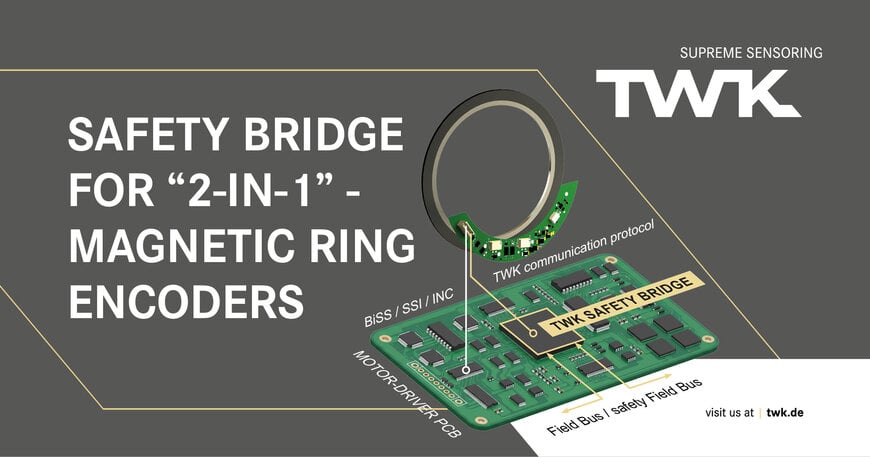
Industrial robots and robotic arms must execute precisely coordinated movements across wide speed ranges while maintaining strict functional safety. Under the ISO 10218-1/2:2025 standard, robot designs must implement safety functions including safely limited position, safely limited speed, and safe stop. To address these requirements while reducing system complexity and cost, sensor specialist TWK has introduced the Safety Bridge concept alongside its new series of ring encoders.
Modular collaboration between motion control and safety sensing
Each robotic joint relies on its own motor drive and real-time controller to manage calibrated acceleration, braking, and positioning, with encoders providing both high-speed motion feedback and safety-related position and velocity monitoring. TWK's modular approach separates specialised functions across clearly defined mechanical and electronic interfaces: robot manufacturers focus on motion control software, user interfaces, and AI models, while TWK supplies certified functional safety position sensing. Because each module operates independently over fixed interfaces, components can be upgraded individually, shortening development cycles and lowering system costs.
Key features of TWK's new ring encoders
- Split rotor-stator construction: Comprises separate rotor and stator elements with inner diameters of up to 200 mm.
- Multi-interface output and configurable resolution: Supports multiple interfaces simultaneously with resolutions of up to 21 bits that can be configured independently for each interface.
- Flexible mechanical form factors: Offered in multiple designs and dimensions—either housed or as a bare-board assembly—with a slim profile for straightforward mechanical integration.
- High-temperature capability: Depending on the specific design variant, the encoders operate at ambient temperatures of up to 125 °C.
How the TWK Safety Bridge eliminates extra joint cabling
Designed for space-constrained measurement points inside robot joints, the Safety Bridge uses a designated section of the motor control board. In close collaboration with the customer, TWK designs the components required for the safe fieldbus interface: EtherCAT FSoE (FailSafe over EtherCAT), PROFIsafe, or CANopen Safety.
At the joint measurement point itself, only the compact, customisable ring encoder is installed. It transmits standard real-time motor control feedback—via BiSS-C, SSI, SIN/COS, or incremental signals—directly to the adjacent motor control board, while simultaneously sending safety-related data to the onboard safety module via the TWK Communication Protocol. Because the robot arm's standard daisy-chain fieldbus already runs sequentially from one motor board to the next, safety data on axis position and speed travels over the existing network without requiring additional cables.
Combining high-speed motor control with position-sensing technology certified to IEC 61508 and ISO 13849-1, the Safety Bridge provides robot manufacturers with a documented safety component ready for modular integration and validation under ISO 10218-1/2:2025, helping to significantly reduce development and system costs.
Additional Context:
This section explains general principles of hollow-shaft ring encoders and safety-over-fieldbus protocols in articulated robotics not included in the original technical article.
In multi-axis industrial and collaborative robot joints, internal space is heavily constrained by harmonic gearboxes, frameless torque motors, electromagnetic brakes, and internal power or pneumatic dress packs routed through the centre of the joint. Traditional shaft-end encoders cannot be mounted centrally when cables pass through the hollow axis, making large-diameter, slim-profile hollow-shaft ring encoders well suited to direct joint-angle measurement.
From a functional safety standpoint, protocols such as EtherCAT FSoE (IEC 61784-3-12) and PROFIsafe operate on the "black channel" principle: safety-critical frames carrying safety data, sequence numbers, and CRC checksums are encapsulated inside standard fieldbus telegrams. This allows safety controllers to detect transmission errors, delays, or data corruption deterministically without requiring separate physical safety wiring through moving robotic joints.
Edited by an industrial journalist, Lekshman Ramdas, with AI assistance.
