
www.automation-mag.com
27
'26
Written on Modified on
Open control technologies for next-generation robot systems
Kawasaki Heavy Industries and Beckhoff Automation have signed an MOU at SPS Smart Production Solutions 2026, stating that they will collaborate on open control technologies for industrial robots.
www.beckhoff.com
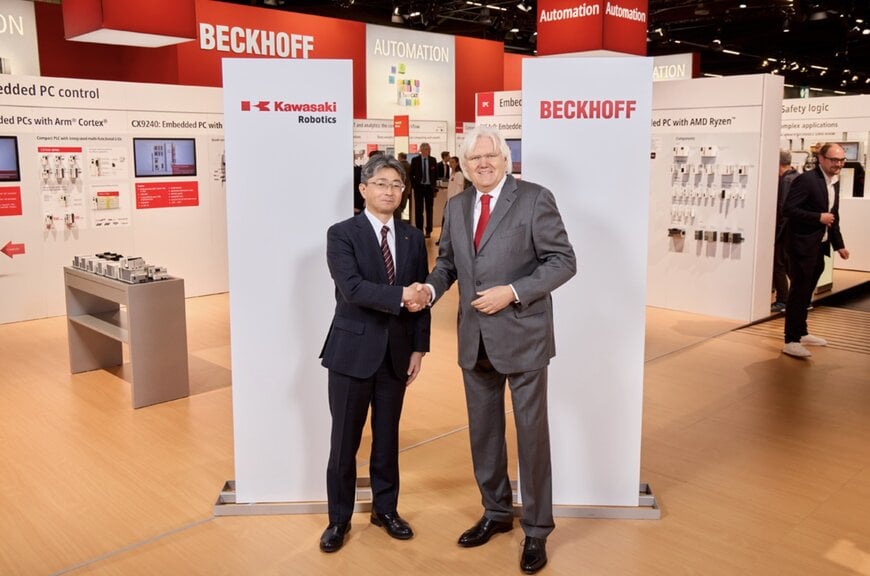
Kawasaki Heavy Industries and Beckhoff Automation have formalized a Memorandum of Understanding during Smart Production Solutions (SPS) 2026 to collaborate on open control technologies for industrial robotics. The technical agreement establishes an engineering framework to evaluate the integration of PC-based control architectures, real-time Ethernet communication, and unified automation software into next-generation robotic manipulators.
Interoperability Bottlenecks in Proprietary Robot Controllers
Modern manufacturing facilities face acute skilled labor shortages and rising demand for high-mix, flexible production lines. Conventional industrial robots typically rely on closed, proprietary controller architectures that isolate robot motion from surrounding machine controls, external sensors, and cloud-based artificial intelligence systems. Bridging disparate communication protocols across multi-vendor automation cells increases system integration overhead, slows commissioning, and restricts autonomous operational scaling. Overcoming these hardware and software silos requires adopting open, deterministic control standards capable of unifying multi-axis kinematics with broader factory automation networks.
Control Architecture and Partner Responsibilities
The collaboration pairs Kawasaki Heavy Industries’ mechanical manipulator design and robotic kinematics expertise with Beckhoff Automation’s PC-based control and industrial communication portfolio. Beckhoff provides the EtherCAT real-time Ethernet communication protocol alongside the TwinCAT automation platform, which consolidates programmable logic control, multi-axis motion control, measurement technology, machine vision, and agentic artificial intelligence execution within a single scalable software architecture.
Building on Kawasaki’s next-generation open EtherCAT-based robot control concept—initially premiered at the International Robot Exhibition (iREX) 2025 in Japan—joint engineering teams will evaluate how standardizing on PC-based control accelerates the deployment of flexible robotic workcells. Replacing proprietary fieldbuses with deterministic EtherCAT networking allows sensors, external axes, and peripheral actuators to synchronize directly with robot trajectory execution at sub-millisecond cycle times.
Core Collaboration Areas and Implementation Scope
Execution under the Memorandum of Understanding focuses on three primary technical and operational pillars:
- EtherCAT Integration: Embedding real-time EtherCAT communication interfaces directly into Kawasaki industrial robot systems to streamline multi-vendor peripheral connectivity.
- PC-Based Control and TwinCAT Evaluation: Assessing the deployment potential of Beckhoff’s PC-based control hardware and TwinCAT software suite for advanced robotic motion, vision, and artificial intelligence workloads.
- Ecosystem Enablement: Establishing joint technical training and engineering support concepts, working directly with system integrators to standardize deployment workflows.
System Integrator Flexibility and Industrial Impact
Transitioning industrial robot controllers toward open, PC-based platforms decouples hardware selection from proprietary vendor lock-in. By giving system integrators and end-users the freedom to combine best-in-class sensors, vision systems, and cloud-connected artificial intelligence tools within a unified control environment, the partnership reduces cell engineering complexity, shortens commissioning cycles, and establishes a scalable foundation for autonomous manufacturing systems.
Edited by Romila DSilva, Induportals Editor, with AI assistance.
