
Siemens Introduces Agentic AI for SIMATIC PCS 7 Process Engineering
Siemens launches Eigen Engineering Agent for Process Industries to automate Continuous Function Chart creation and control logic verification in SIMATIC PCS 7 projects.
www.siemens.com
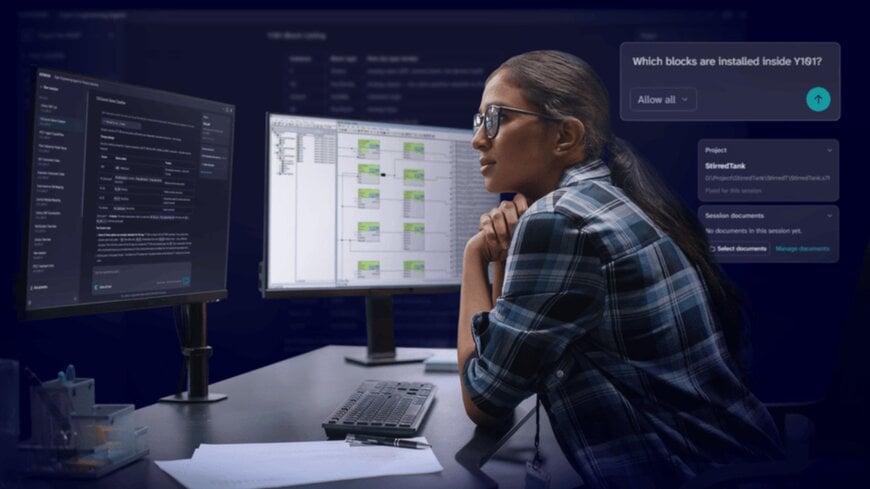
Continuous process industries—including chemical, pharmaceutical, and oil and gas manufacturing—rely on distributed control systems (DCS) to govern complex, multi-decade production assets. Engineering and modifying these facilities requires translating vast instrument and equipment spreadsheets—detailing thousands of sensors, valves, and pumps with specific alarm limits and scaling parameters—into structured control logic. Conventionally, automation engineers transcribe these lists manually into the control environment and cross-check every signal routing against plant specifications, a workflow that can span weeks or months. Furthermore, during brownfield plant modifications, incomplete project documentation often forces engineers to spend hours manually tracing interlocks and signal paths across legacy Continuous Function Charts (CFCs) to avoid unintended operational disruptions. Addressing these engineering bottlenecks requires agentic artificial intelligence tools capable of parsing structured engineering data, interpreting existing control architectures, and generating validated automation modules within established DCS environments.
Agentic Control Logic Analysis and Automated Module Generation
To accelerate process automation engineering, Siemens is extending its Eigen Engineering Agent portfolio to the process industries, scheduled for presentation at the SPS 2026 trade fair in Nuremberg, Germany. Initially launched in April 2026 for discrete factory automation within the TIA Portal software environment—where its global paid license base more than tripled between July and October 2026 across more than 30 countries—the new Eigen Engineering Agent for Process Industries is engineered specifically for plants operating SIMATIC PCS 7 starting at version 10.
At commercial launch, the software targets two primary engineering workflows: analyzing existing control logic and generating standardized control modules from raw engineering lists. Within CFC engineering, engineers can query existing projects using natural language to trace signal connections, such as identifying which signals connect to a specific pump or tracking how a temperature signal propagates into shutdown logic. The agent responds with explanations grounded directly in the active project configuration, navigates large project structures, flags configuration errors like missing connections or inconsistent settings, and assists in building new charts.
For bulk module configuration, Eigen processes engineering lists by mapping sensors, valves, and pumps to standardized project library templates known as Control Module Types (CMTs). For each device, the agent selects the appropriate CMT, creates a corresponding CFC, applies the plant’s tag naming structure, and populates parameters including alarm limits and measurement units. Before engineers apply any changes, the agent checks the generated logic against engineering data and customer standards, verifies signal addresses, and recommends fixes for missing connections. When updated engineering lists are uploaded, Eigen proposes changes only where the data differs.
Operational Governance, Efficiency Potential, and Industry Deployment
Based on initial estimates for selected engineering use cases, Siemens sees time-saving potential of around 20 percent to 60 percent for specific tasks, depending on project complexity, engineering scope, existing SIMATIC PCS 7 expertise, and the degree of standardization. Eigen works within the PCS 7 engineering environment, separate from the running plant, so that all AI-generated proposals are reviewed by engineers and pass through established testing and approval procedures before moving to production. Customers retain ownership of their data.
Rebecca Vangenechten, Senior Vice President Supervisory & Control Systems at Siemens, noted that process plants frequently operate and evolve for decades with critical engineering knowledge embedded in the projects themselves, and that making this knowledge accessible helps PCS 7 users extend and adapt plants faster while retaining full control over their intellectual property. Vasi Philomin, Executive Vice President Data and AI at Siemens, emphasized that the biggest opportunity for AI agents lies in the handovers between teams and disciplines, with Eigen translating plant designs into configured, validated automation projects. Chemical company BASF is among the first users to test the agent, with Dr. Tobias Gerber, Vice President Technical Expertise Europe at BASF SE, describing industrial AI as a key enabler of leaner, easier-to-maintain, and more agile production systems. Offered as a separate subscription alongside existing SIMATIC PCS 7 licenses, the agent also supports customers in protecting their investment and preparing for SIMATIC PCS neo, Siemens’ next-generation distributed control system.
Additional Context
This section details technical specifications and competitive benchmarking not included in the original product announcement.
In process automation engineering guided by standards such as IEC 61131-3 for programmable controller languages and NAMUR recommendations for process control system interfaces and field device diagnostics, SIMATIC PCS 7 uses Continuous Function Charts to graphically interconnect standardized function blocks, such as those of the Advanced Process Library (APL). Engineering efficiency in large DCS projects relies heavily on object-oriented bulk engineering through Control Module Types, which separate hardware I/O assignments from standardized control algorithms and operator faceplates. Traditionally, transferring instrument lists derived from Piping and Instrumentation Diagrams (P&IDs) into PCS 7 relied on spreadsheet-based bulk engineering, dedicated import tools, or manual configuration, where transcription errors in alarm limits, signal scaling, or interlock logic often surfaced only during Factory Acceptance Testing (FAT).
Within the DCS engineering software market, Siemens’ Eigen Engineering Agent for Process Industries benchmarks against engineering-efficiency and AI-assisted configuration initiatives from Emerson (DeltaV), ABB (System 800xA and Genix industrial AI), Honeywell (Experion PKS and Honeywell Forge), and Yokogawa (CENTUM VP). While many established approaches rely on rule-based bulk-import templates, automated loop-checking scripts, or general-purpose generative assistants not connected to the live project database, Siemens embeds agentic reasoning directly in the native SIMATIC PCS 7 engineering environment. By grounding queries in the actual CFC signal topology and CMT library while keeping the agent separate from runtime controllers, Siemens offers a verifiable, human-in-the-loop engineering workflow suited to regulated chemical and pharmaceutical facilities.
Edited by Romila DSilva, Induportals Editor, with AI assistance.
