
www.automation-mag.com
20
'26
Written on Modified on
Push-In Termination Connector Inserts Cut Field Assembly Time
HARTING adds 14 Han Push-In monobloc inserts for Han E, Han EE, Han D and Han A, enabling tool-less field wiring of connectors.
www.harting.com
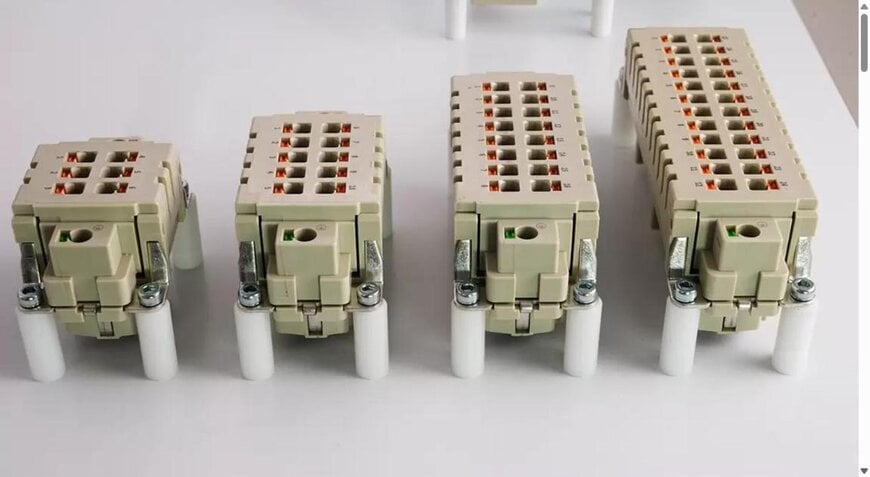
Heavy-duty rectangular connectors are often wired on site, in control cabinets, machine modules or energy installations where space is limited and assembly time directly affects commissioning schedules. In these conditions, the termination method of the connector insert determines how quickly and reliably conductors can be connected. HARTING has expanded its Han Push-In monobloc range with 14 new one-piece connector inserts designed for tool-less field assembly.
Termination Challenges in Field Assembly
Screw and crimp terminations require tools, defined tightening torques or crimping equipment, and each conductor must be handled individually. When connectors are assembled at the installation site rather than in a workshop, these steps add time and create variation in connection quality. Field assembly is common in energy applications and when machine modules or production lines are installed and connected on site.
How Push-In Termination Works
Push-In technology is a further development of the cage spring connection. Conductors fitted with wire end ferrules are inserted directly into the contact chamber. When the ferrule reaches the bottom of the chamber, an internal clamping spring secures the strand and provides tensile strength. For stripped strands without ferrules, pressing the orange actuator with a screwdriver holds the spring open while the conductor is inserted. HARTING recommends using ferrules, but stranded wires and solid conductors can also be connected.
New Han E, Han EE, Han D and Han A Push-In Inserts
The new Han Push-In monobloc inserts cover the Han E and Han EE series in four standard sizes (Han 6, 10, 16 and 24) and the Han D and Han A series in two standard sizes (Han 10 and 16). According to HARTING, direct insertion of the conductor reduces assembly time by up to 30 percent compared with alternative termination technologies. The inserts are compatible with identical products that use other termination methods, so existing connector housings and mating sides can be retained.
Green PE Actuator for Safer Wiring
For the first time, the Push-In monoblocs feature a green actuator for the protective earth (PE) contact. It is clearly distinguished from the orange actuators of the power and signal contacts, which reduces the risk of wiring errors on the protective conductor during field assembly.
Applications in Energy and Machine Building
The inserts are intended for environments with little space for installation, assembly and maintenance. Typical use cases include energy applications, the installation of machine modules and the connection of production lines. Tool-less handling also simplifies maintenance work, as conductors can be released and reconnected without special equipment.
Additional Context
This section details technical specifications and competitive benchmarking not included in the original product announcement.
Spring-based termination methods for industrial connectors have gained ground over screw terminals because the contact force is applied by the spring rather than by the installer, which removes torque-related variation and reduces sensitivity to vibration. Clamping units for copper conductors are covered by IEC 60999-1, while heavy-duty connectors themselves are specified under IEC 61984. Push-in variants differ from conventional cage clamp terminals mainly in allowing ferruled or solid conductors to be inserted without opening the spring first, which is the main source of the time savings cited by manufacturers.
Edited by Evgeny Churilov, Induportals Media - Adapted by AI.
www.harting.com
