
www.automation-mag.com
12
'26
Written on Modified on
Siemens introduces stainless steel Intelligent Valve for liquid cooling
The new valve meets stringent wetted material requirements for direct-to-chip cooling with independent, scalable control.
www.siemens.com
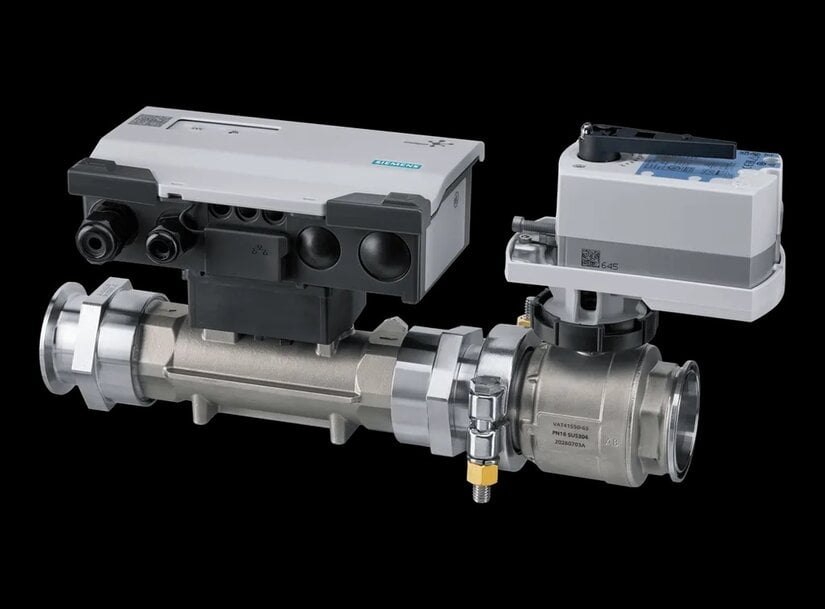
Siemens has expanded its liquid cooling portfolio with a new stainless steel variant of its ‘Intelligent Valve,’ designed specifically for direct-to-chip rack loop cooling applications in AI data centers and high-performance computing (HPC) environments. The stainless steel construction addresses increasingly strict wetted material specifications mandated by hyperscale operators and leading chip manufacturers, serving as a high-purity alternative to traditional brass components. This release aims to support the rapidly growing global liquid cooling market, ensuring media compatibility as compute densities escalate.
Integrated control and scalable automation
Installed directly within the hydronic cooling circuit, the Intelligent Valve continuously monitors critical parameters such as temperature, flow, and overall system performance. At the rack level, it actively maintains a stable differential pressure, ensuring consistent coolant flow while protecting delicate IT equipment from pressure peaks that could cause leaks or damage to cold plates during operations and maintenance. Crucially, the valve adapts automatically to hydraulic changes, such as when servers or entire racks are added or replaced.
The device features integrated local control loops that can operate independently of the primary coolant distribution unit (CDU) controller. With automatic presetting capabilities and open communication interfaces, the valve facilitates rapid commissioning and seamless integration into broader automation and Data Center Infrastructure Management (DCIM) systems. It is compatible with various cooling media, including pure water, water-ethylene glycol, and water-propylene glycol mixtures. According to Nawfal Slimati, EVP Buildings Products at Siemens, combining proven hydronic technology with sensing and intelligence enables operators to build adaptive cooling infrastructures that evolve alongside computing requirements.
Additional Context:
This section details market projections and liquid cooling adoption trends not included in the original press release.
The transition from traditional air cooling to advanced liquid architectures is accelerating rapidly as artificial intelligence and machine learning workloads mandate extreme rack densities. According to industry analysis by Mordor Intelligence, direct-to-chip liquid cooling—the specific application targeted by the new Siemens valve—accounted for a 42.79% share of the data center liquid cooling market in 2026. This dominance is driven by its ability to scale efficiently across massive processor populations in hyperscale and supercomputing installations.
Furthermore, as liquid cooling penetration deepens, the aftermarket demand for specialized ancillary components—such as sensors, quick-disconnect couplings, and stainless steel control valves—is emerging as a critical necessity for facility operations. The demand is heavily concentrated in North America, which led the global liquid cooling market with a 36.97% share in 2026, though the Asia-Pacific region is projected to experience the fastest growth over the next five years. The integration of intelligent, automated valves directly into the thermal loop allows facility operators to dynamically shift workloads to racks with optimal thermal headroom, protecting multibillion-dollar investments in high-density GPU clusters.
Edited by an industrial journalist, Lekshman Ramdas, with AI assistance.
www.siemens.com
