
www.automation-mag.com
03
'26
Written on Modified on
Embedded Perception Architecture for Industrial Vehicle Automation
ACTIA integrates the Renesas R-Car V4H platform into its High-Performance Computer to resolve multi-camera sensor fusion and real-time operator protection challenges.
www.actia.com
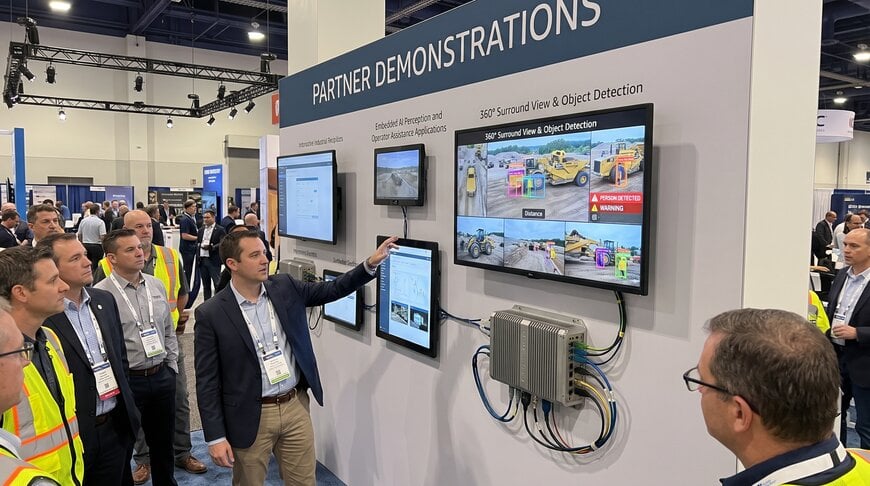
ACTIA and Renesas Electronics have integrated the Renesas R-Car V4H processor into ACTIA's High-Performance Computer (HPC) to implement real-time embedded perception and advanced driver assistance systems (ADAS) for specialized machinery. The technical cooperation targets safety-critical applications in agricultural machinery, mining equipment, construction platforms, and airport ground support vehicles.
Hardware Consolidation in Industrial Automation
Deploying machine vision in heavy vehicles requires low latency and high computational bandwidth without compromising mechanical durability. Harsh operating conditions eliminate the option of active fan cooling, which is vulnerable to dust, vibration, and thermal stress. The ACTIA HPC addresses this challenge by combining the computing, video processing, and neural network acceleration of the Renesas R-Car V4H system-on-chip with ACTIA's ruggedized electronic packaging.
This integration supports the transition from distributed electronic control units (ECUs) toward centralized vehicle architectures. A single passively cooled unit consolidates four core operational workloads: digital instrumentation clusters, infotainment systems, ADAS functions, and embedded artificial intelligence.
Technical Specifications and Sensor Fusion Mechanism
The processing platform interfaces with up to eight camera inputs, four independent display units, and multiple Ethernet, USB, and CAN communication buses. In active deployments, a four-camera surround configuration captures video streams that undergo hardware-level distortion correction and spatial synchronization.
The Renesas R-Car V4H executes deep learning models directly on edge hardware to identify, track, and classify surrounding personnel and machinery. Relative coordinates and velocity vectors are evaluated continuously across predefined geometric thresholds. Output states are classified into binary risk parameters:
Non-critical state: Personnel detected outside predefined danger envelopes remain monitored without driver alert intervention.
Critical state: Personnel entering hazardous operating proximity trigger automated visual alerts on the in-cab ACTIVISION display and transmit deterministic control signals across the vehicle CAN bus to engage automated braking or motion inhibition.
Validation and Standard Deployment
The system is being evaluated under the PROTECH development initiative, supported by Bpifrance under the France 2030 investment plan, which aims to achieve zero-accident operations in off-road industrial sites. Field testing focuses on vision-based risk classification under changing ambient lighting, dirt obstruction, and high vibration levels.
"The R-Car V4H delivers high-performance computing and AI processing capabilities for advanced perception applications," stated Kevin Guillemet, Vice President Sales EMEA at Renesas. "Its integration into ACTIA's HPC demonstrates how Renesas technology and ACTIA's embedded systems expertise can be combined to address new operator assistance use cases in industrial and off-road vehicles."
The technological architecture was showcased at the Electronica trade fair from November 10 to 13, 2026, in Munich, Germany, confirming that centralized sensor fusion hardware can execute deterministic operator protection while reducing total vehicle cabling complexity.
Edited by Evgeny Churilov, Induportals Media - Adapted by AI.
www.actia.com
