
www.automation-mag.com
23
'26
Written on Modified on
KUKA and Visual Components Link Digital Twins to Physical AI
KUKA and Visual Components integrate NVIDIA Omniverse and Jetson architectures to bridge factory simulation, intelligent vision perception, and shop-floor automation.
www.kuka.com
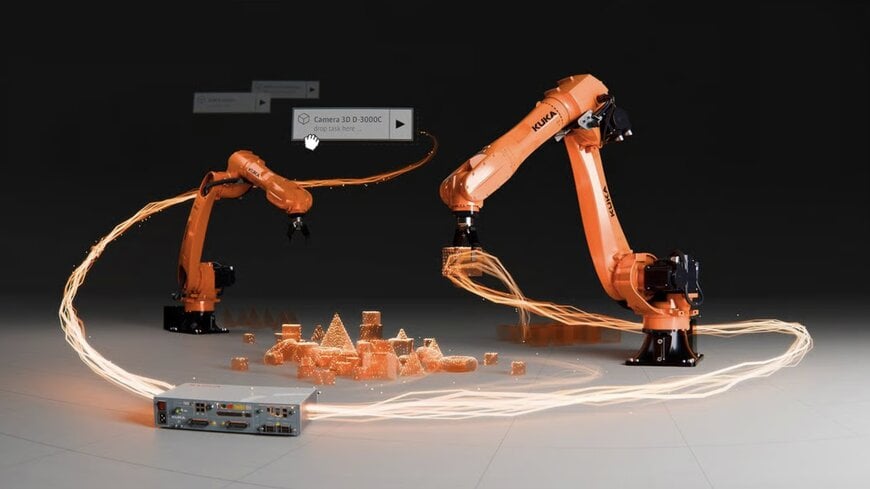
Modern industrial manufacturing environments require high-mix production flexibility, tight cycle times, and adaptive automation capable of adjusting to real-time physical variances. Historically, factory design and robotic deployment have operated in disconnected silos: manufacturing layout design occurs in standalone three-dimensional simulation tools, robot programming relies on fixed offline scripts, and shop-floor execution depends on deterministic controllers lacking adaptive sensory feedback. When physical parts diverge from computer-aided design tolerances or shift during handling, rigid automation systems fault out, halting entire production cells. Bridging this operational divide requires high-fidelity digital twins embedded with real-time physics and rendering, intelligent edge-based vision perception, and unified software platforms capable of orchestrating robotic fleets across enterprise production lines.
Real-Time Digital Twin Simulation with FactoryLens
At NVIDIA GTC Berlin, Visual Components, a specialist in three-dimensional manufacturing simulation and offline robot programming, introduced FactoryLens, an integrated viewport embedded directly into its core simulation platform. Engineered using NVIDIA Omniverse libraries, FactoryLens enables industrial planners to transform standard manufacturing simulations into photorealistic digital twins without migrating CAD models into external third-party rendering suites.
The integrated viewport provides real-time rendering, material property management, and cinematic video capture within the existing Visual Components interface. Crucially, the system supports bidirectional data exchange using Universal Scene Description (OpenUSD), allowing production engineers to export detailed factory configurations into external digital-twin platforms and physics engines. By maintaining layout logic and visual properties within a single design environment, manufacturing teams can validate cycle times, eliminate robotic kinematic collisions, and optimize material-flow routing prior to capital equipment procurement.
Embedded Edge Perception via iiQKA.AI Vision
To convert simulation data into adaptive shop-floor action, KUKA demonstrated iiQKA.AI Vision, an artificial intelligence vision platform engineered to deliver physical perception directly at the machine controller level. Powered by the NVIDIA Jetson Orin system-on-module, the solution integrates into the native KUKA industrial robot control architecture.
By executing deep learning perception models directly on the robot controller, iiQKA.AI Vision enables industrial arms to recognize unoriented components, compensate for geometric part variations, and interpret unstructured visual scenes in real time. This integrated vision processing reduces the need for specialized part-feeding fixtures and complex external vision PCs, expanding robotic automation into quality inspection, bin picking, and dynamic assembly tasks that traditionally required dedicated manual labor.
Orchestrating Physical AI with KUKA AMP
Connecting virtual planning to physical execution requires an overarching operational layer. Following its initial preview at NVIDIA GTC in San Jose, KUKA deployed its Automation Management Platform (KUKA AMP) into live production at KUKA Toledo Production Operations in Ohio, an automotive assembly facility that builds body-in-white structures for major automakers.
KUKA AMP functions as an open, modular software architecture that integrates, monitors, and orchestrates heterogeneous automation assets—spanning autonomous mobile robots, six-axis articulated manipulators, and automated material handling lines. Working in coordination with FactoryLens digital twins and iiQKA.AI Vision edge nodes, KUKA AMP aggregates live production telemetry to optimize asset utilization and support adaptive factory workflows, transitioning facilities from rigid deterministic lines to intent-driven Physical AI operations.
Additional Context
This section details technical specifications and competitive benchmarking not included in the original product announcement.
In industrial automation software standards, factory simulation workflows are governed by ISO 10303 (STEP AP242) for product geometry, ISO 18629 (Process Specification Language), and OPC Unified Architecture (OPC 40001-1) for open robot communications. While legacy digital manufacturing software suites—such as Siemens Tecnomatix Process Simulate, Dassault Systèmes DELMIA, and Rockwell Automation Emulate3D—traditionally rely on proprietary, polygon-limited rasterization pipelines, Visual Components' implementation of OpenUSD via the Omniverse Hydra rendering architecture enables multi-layer material definitions (MaterialX) and physics-based ray tracing across complex multi-robot assembly plants without downsampling geometry.
In edge vision processing and robot control architectures, KUKA’s integration of the NVIDIA Jetson Orin module directly within its iiQKA OS and KR C5 controller platform benchmarks against competitive smart robotics platforms from Fanuc (CRX series with integrated iRVision), ABB (OmniCore controllers with integrated Cognex vision), and Yaskawa (YRC1000 with MotoSight). While traditional industrial robot vision controllers rely on separate industrial personal computers connected over Ethernet/IP or Profinet fieldbuses—introducing communications latency between image capture, inference, and trajectory recalculation—the Jetson Orin architecture provides up to 275 trillion operations per second (TOPS) of sparse INT8 tensor performance over unified memory. This onboard processing allows convolutional neural networks and transformer vision models to calculate real-time six-degree-of-freedom grasp poses and trajectory offsets within the controller's deterministic motion cycle, enabling dynamic grasp adaptation without external line arbitration delays.
Edited by Romila DSilva, Induportals Editor, with AI assistance.
www.kuka.com
