
www.automation-mag.com
17
'26
Written on Modified on
Machine vision enables sub-micrometre inspection and traceability
Bertram Elektrotechnik uses MVTec HALCON in a fully automated line for solenoid valve armatures.
www.mvtec.com
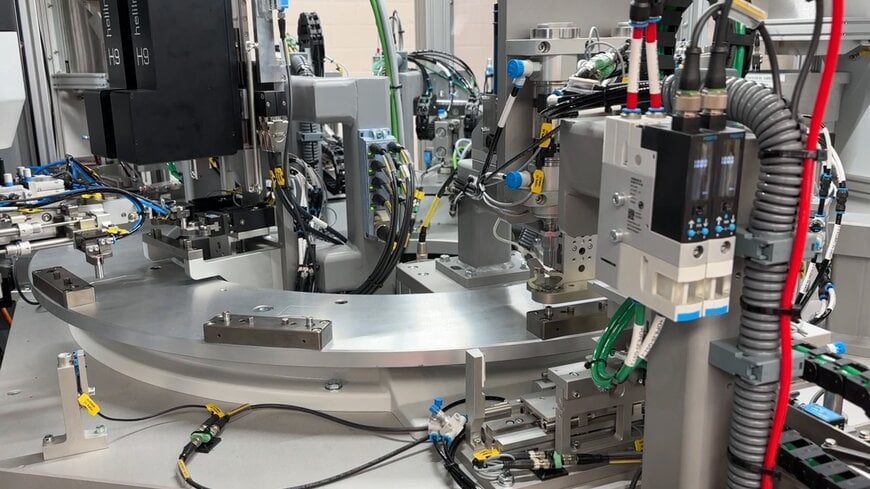
Bertram Elektrotechnik GmbH has developed a fully automated system for producing solenoid valve armatures that combines assembly, inspection and packaging in a single process, with MVTec HALCON machine vision software supporting everything from barcode reading to position and presence checks and the final 3D quality inspection. Founded in 1949 and headquartered in Germany, Bertram works in automation technology, control cabinet construction and machine vision, focusing on special-purpose machinery, particularly automated assembly machines with integrated testing technology. The company was commissioned by a customer in the plant engineering sector, which had previously produced the armatures on a separate, slower assembly machine and inspected them visually by hand, and only on a spot-check basis. The aim was to expand capacity and significantly improve quality control.
Assembly on a rotary indexing table
Each armature measures approximately 8 to 9 mm in diameter and 20 to 25 mm in height and consists of six components: a blank, a small sealing insert, a small spring, a rivet, a large spring and a large sealing insert. The system works with two lanes, producing two armatures per cycle in approximately seven seconds, or one armature roughly every 3.5 seconds. A SCARA robot unloads the raw parts from the tray and places them on a rotary indexing table, which cycles them through the processing stations where the small sealing inserts, small springs and rivets are assembled. The rivet is checked for presence, followed by the assembly and inspection of the large spring. At the final assembly station, the large sealing inserts are placed into an oiled press-fit gland and pressed in using an assembly plug. A second SCARA robot then transfers the armatures to the optical inspection station. Non-conforming parts are ejected via a separate drawer, while conforming parts are placed in blister packs and conveyed out of the system in stacks of four. According to Managing Director Jendrik Bertram, the combination of very small components, delicate sealing inserts and springs, precise assembly and a short cycle time would not be economically feasible without machine vision.
Sub-micrometre inspection
The quality inspection uses two Heliotis white-light interferometers, with a grip-and-swing module rotating each armature by 180 degrees so that both sides can be inspected. The system verifies the press-fit depth of the sealing inserts, the dimensional accuracy of the armatures and the surface finish of the sealing inserts, with accuracies in the sub-micrometre range. Jendrik Bertram explains that conventional sensor technology is not sufficient, as dimensional accuracy and surface defects must be inspected on two different materials, steel and rubber, across the entire surface, without contact, on both sides and within the cycle time. The technology also enables 100% inspection, traceable measurement values and visualisation of defect patterns, which supports serial defect detection and trend analysis.
One software platform for several tasks
HALCON performs three key tasks in the system: it reads the barcodes on the trays for component traceability, checks the position and presence of components in the assembly stations using shape matching, and carries out the final optical inspection. During this inspection, the 3D height data from the two Heliotis sensors is analysed directly in HALCON using 3D operators to select relevant 3D points, segment object models, calculate distances, merge 3D data and perform coordinate transformations. Most inspections, including press-fit depth, dimensional accuracy and surface features, are performed directly on the 3D data. Bertram creates the machine vision tasks in HDevelop, MVTec's integrated development environment, and integrates them into the runtime. Communication with the Siemens PLC takes place via OPC UA, with the interface generated automatically from the procedure parameters of the HALCON jobs, and image acquisition, evaluation and feedback to the PLC run in sync with the rotary indexing table. Jan Gärtner, HALCON Product Manager at MVTec, says the application shows how standard software can cover identification, position determination, presence checking, 3D measurement and surface inspection within a single system.
Results in production
The system has been commissioned by the end customer and has since been expanded to include additional product variants. Production capacity has increased and quality inspection has improved, with the system operating at the required cycle time and providing traceable, inline 100% inspection. Jendrik Bertram expects machine vision to continue gaining importance in custom machine building, as tasks become more demanding, the number of variants grows and customers increasingly expect complete inspection directly on the production line.
Additional Context:
This section explains general principles of white-light interferometry not included in the original press release.
A white-light interferometer splits light from a broadband source into two paths, one reflected from a reference mirror and one from the surface being measured. When the two beams are recombined, interference fringes appear only where the two path lengths match very closely, because white light has a very short coherence length.
By scanning the distance between the sensor and the surface and recording where the fringes appear for each pixel, the instrument builds a height map of the surface. This allows very fine height differences to be measured without contact, which makes the method suitable for checking small features such as press-fit depths and surface finish on delicate components.
Edited by an industrial journalist, Lekshman Ramdas, with AI assistance.
www.mvtec.com
